
Electoral College Delegates and the States That Appoint Them
State governors, U.S. congressmen, and thousands of officials of lower levels of government are elected by popular vote. The U.S. president and vice president are exceptions. Why?
The U.S. Constitution’s writers struggled with how to choose the president. States were granted a role by appointing “electors” to make the final decision. This conclusion was the result of a compromise among delegates to satisfy small-population states, states with large slave populations, and congressmen who feared direct popular voting and wanted a separate body of informed citizens. Each state’s electors are appointed “in such manner as the legislature thereof may direct.” The conflict surrounding passage is described by Jesse Wegman, a member of the New York Times editorial board, in a book titled Let the People Pick the President: The Case for Abolishing the Electoral College.
A proposal has been put before the states and District of Columbia to change the way the states’ electors are instructed to vote. Currently states direct their electors to vote for the candidate receiving the majority of their state’s popular vote. The “National Popular Vote Interstate Compact” is described by Wegman as “an agreement among states to award all of their electors to the winner of the national popular vote.” When the total of such electors reaches 270, the candidate who won the national popular vote becomes president.
As of summer 2026, 18 states and the District of Columbia 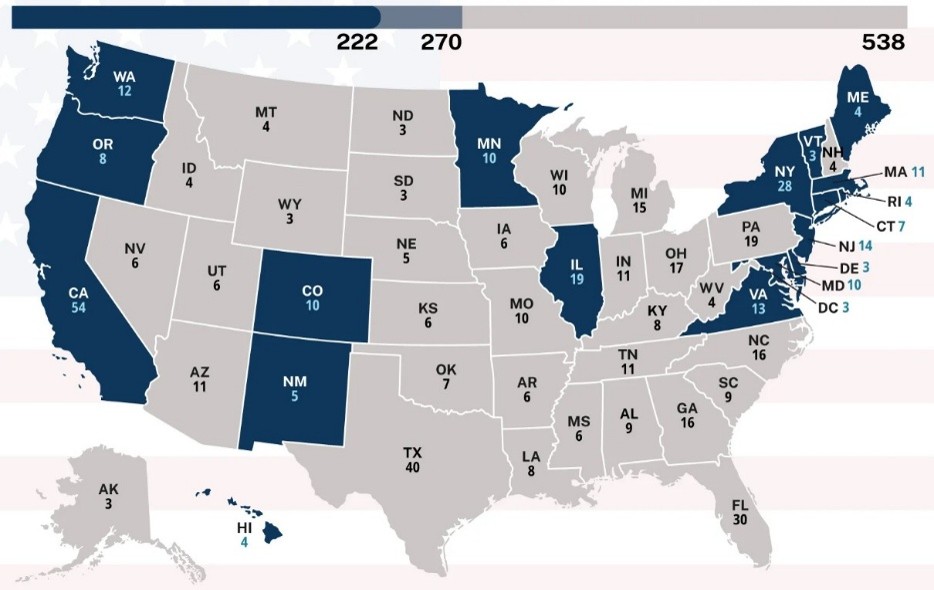 had approved the compact, with a total of 222 electoral votes, 48 votes short of the 270 votes necessary to take effect. (Click on map to enlarge.) All these states’ electoral votes went to Kamala Harris in 2024 except Maine which splits its four votes proportionally. All these states have Democratic governors. They are a combination of large, middle-size, and small-population states, no different in that respect than the 32 states that have not approved the compact.
Republican distaste for the compact is not unexpected, given that two Republican presidents, George W. Bush and Donald Trump, have been elected in this century without receiving a popular vote majority. Seven states identified as “swing states” voted Republican in the 2024 presidential election. Arizona, Georgia, Michigan, Nevada, North Carolina, Pennsylvania, and Wisconsin have 93 electoral votes between them, more than enough to reach the 270-vote goal should they sign on to the compact. What influences a state legislature’s decision to approve the compact?
Wegman describes arguments presented for not adopting the compact. Wyoming has 577,000 residents and 3 electoral votes, the minimum under the Constitution. “This means that in the presidential election, a Wyomingite’s vote counts nearly four times as much as a Californian’s,” where nearly 40 million residents get 55 electoral votes. While this may be perceived as a benefit by small-population states, “of the 13 states with three or four electoral votes, 12 vote reliably Democratic or Republican.” They are of little consequence for candidates seeking election.
But it is not only small-population states that are effectively ignored in a winner-takes-all system. Presidential campaigns focus their attention from the very beginning on those states that will make a difference in the election. Wegman quotes the blunt assessment of one national campaign director: “Which states are so blue, which are so red – they’re not going to be an impact. You do that, and automatically, 100 million Americans are out of the conversation.”
Wegman adds, “Every four years the major parties effectively write off 40 states – big, small, and in between – because the vote in those states is clear in advance.” The Republican Party or the Democratic Party will almost certainly win the popular vote in those states and take all the electoral votes. Twenty-four Republican states, eight Democratic states, and the Democratic-voting District of Columbia gave their winning candidate at least a ten-percentage-point winning margin in the 2024 presidential election. Candidates do not need to spend their money or their time in those 32 states and Washington, D.C.
What would those states get under the national popular vote compact that they are not getting now? Attention. Each person’s vote would be just as valuable as everyone else’s. Voters in every state – large, middle-size, small, urban, rural, conservative, liberal – would have the opportunity to communicate their sentiment to each presidential candidate.
It wouldn’t take too many swing states to push the compact to its goal. But the story wouldn’t end there. Like so much about government today, there would surely be court challenges.